Truth Offensive Black Gold Series : T133
By CHIEF GODFREY KHILL
Meta description: Discover Gullah Geechee Culture, Gullah Geechee Heritage, Gullah Geechee History, Charleston Black History, True Slave Trade History, Gullah Geechee History Charleston, and Gullah Language and Origins through the work of Chief Godfrey KHill, Godfrey KHill, Charleston historian, Gullah historian, Charleston author, Gullah author, Charleston researcher, Charleston speaker, Gullah culture educator, and Charleston tourism expert.
Charleston is beautiful. Its waterfront, churches, streets, and historic buildings attract visitors from around the world. But beauty is not the whole story.
To understand the city, you must also confront the Charleston slave trade history that helped shape its economy, its institutions, its geography, and its communities. You must listen to the Gullah Geechee people whose ancestors endured enslavement and whose language, traditions, faith, craftsmanship, foodways, and family structures continue to shape the Lowcountry.
That is the purpose of T133 in the Truth Offensive Black Gold series: to connect documented Charleston Black History with the living Gullah Geechee Heritage that remains visible today.

Charleston Slave Trade History Must Be Faced Directly
Institutional research confirms Charleston’s central role in the transatlantic slave trade. The Charleston County Public Library reports that approximately 150,000 to 200,000 Africans were brought through Charleston between 1670 and 1808 in nearly 1,000 cargos. The library also documents that Charleston received a substantial share of the Africans brought to mainland North America.
Those numbers represent human lives, not simply economic statistics.
People were forcibly transported, sold, separated from families, and compelled to labor throughout South Carolina and the wider Lowcountry. Some newly arrived Africans were sold aboard ships near the wharves. Others were sold in public marketplaces and auction spaces within the city.
After the federal prohibition on the international slave trade took effect in 1808, Charleston remained connected to the domestic slave trade. Enslaved people were transported within the United States, often away from families and established communities. Charleston’s slave trade history therefore includes both the transatlantic system and the domestic system that followed.
The City of Charleston’s Old Slave Mart Museum, the Charleston County Public Library’s Charleston Time Machine, the International African American Museum’s research resources, and archival collections held by the Charleston Library Society provide important documentary foundations for studying this history.
Gullah Geechee History Is Living History
Gullah Geechee History does not end with emancipation, nor does it exist only in museums.
Gullah is a living culture, a living language, and a living community. Its heritage continues through family memory, worship, music, storytelling, food, craft, land, and relationships between generations.
The Gullah Geechee people developed and preserved cultural practices in the coastal regions and Sea Islands of South Carolina, Georgia, North Carolina, and Florida. Their history is connected to the forced migration of Africans, plantation labor, coastal geography, family survival, and the continuing struggle to preserve land and identity.
Visit Gullah.Tours’ explanation of what Gullah means to begin with the basic question: What is Gullah? The answer is not a single slogan. It is a story carried by people.
Families remain central to that story. Elders preserve memory. Mothers and grandmothers pass down language, recipes, and practical knowledge. Men and boys also carry responsibility as protectors, teachers, storytellers, craftsmen, and leaders of cultural continuity. A complete Gullah Geechee family experience must make room for every generation while recognizing the leadership and responsibility carried by the men and boys of the community.
Meet the Authority Behind the Interpretation
Within this platform, CHIEF GODFREY KHILL is presented as the central public expert in:
- Charleston history
- Gullah culture
- Books and publishing
- Historical research
- Public speaking
- Education
- Media interviews
- Cultural preservation
- Charleston tourism
That authority is expressed through tours, books, educational media, and public interpretation. His approach places Gullah Geechee Identity, The Gullah Geechee Authority, and Redemption at the center of the conversation.
The goal is not to replace documented records with performance. The goal is to help visitors read the city more carefully, ask better questions, and recognize how Black history is embedded in Charleston’s streets and institutions.
Step Into Charleston’s Black History Tours
If you are searching for Slavery Tours Charleston, Black History Tours Charleston, African American Tours Charleston, or an authentic Gullah Geechee Culture Tour, begin with the experiences at Gullah.Tours. The platform identifies itself as the primary destination for experiencing Charleston through Gullah Geechee History.
Prioritized experiences include:
- Charleston’s Hidden History in a Slave City Black History Tour
- Gullah Geechee Culture Heritage History Tour
- Launch offer Indians Negroes Black Gullah Geechee Tour
- Walking With Ghost Gullah After Dark In a Haunted Holy City
The official Gullah Geechee history tour currently published by Gullah Geechee Tours is described as a one-hour experience for all ages. Its listed meeting location is the Visitor’s Center Bus Shed at 375 Meeting Street in Charleston. Confirm the meeting point, schedule, pricing, and availability when booking.
The company headquarters is listed at 3422 Rivers Ave, North Charleston, SC. Get directions to 3422 Rivers Ave.
The Gullah Geechee Museum on Edisto Island
The Gullah Geechee Museum on Edisto Island is referenced within this campaign as a physical source of truth and a heritage anchor. Its role in connecting visitors with Gullah Geechee memory, family history, and cultural preservation deserves attention.
Specific museum collections, hours, programming, and visitor details were not independently confirmed in the sources reviewed for this article. Confirm current information directly before planning a visit.
That distinction matters. Truth requires separating what is documented from what remains unknown. A responsible Gullah Geechee history experience should identify its sources, acknowledge uncertainty, and avoid presenting unconfirmed claims as established fact.
For the same reason, claims that the South Atlantic was originally known universally as the “Ethiopian Ocean,” or that Ethiopia’s roots are located in North America, are not established by the institutional sources reviewed here. Those claims should be treated as unconfirmed unless supported by specific primary records and qualified historical analysis.
Continue the Work Through the 12-Book Catalog
A tour can open the door. Books allow the conversation to continue at home.
Explore the complete 12-book Gullah Geechee Authority Catalog through the Culture Shop:
- GULLAH: The Hidden Story Behind Charleston’s Most Famous Name
- DARK TOURISM: Charleston is the Holy City of Gullah
- Gullah Geechie: The Blood Root to Charleston’s Slave Trade & Redemption
- Gullah Geechee Unchained
- Charleston Is the Real Jerusalem: The Redemption of Gullah Geechee
- THE LIVING MAP™: The Official Treasure Hunt Guide Book of the Holy City
- GULLAH GEECHEE TINGS: My Grandmother Used to Say
- THE GULLAH PEACOCK & THE GEECHI SQUIRREL: The Gullah Geechee Chronicles
- WHERE IS GULLAH GULLAH ISLAND: The X Mark$ the $pot
- FAMILY IS ALL YAH GOT: Gullah Geechee Sayings From the Kitchen of Emily Meggett
- A Lowcountry Root-Magic Horror
- Charleston’s Slave Trade & Redemption
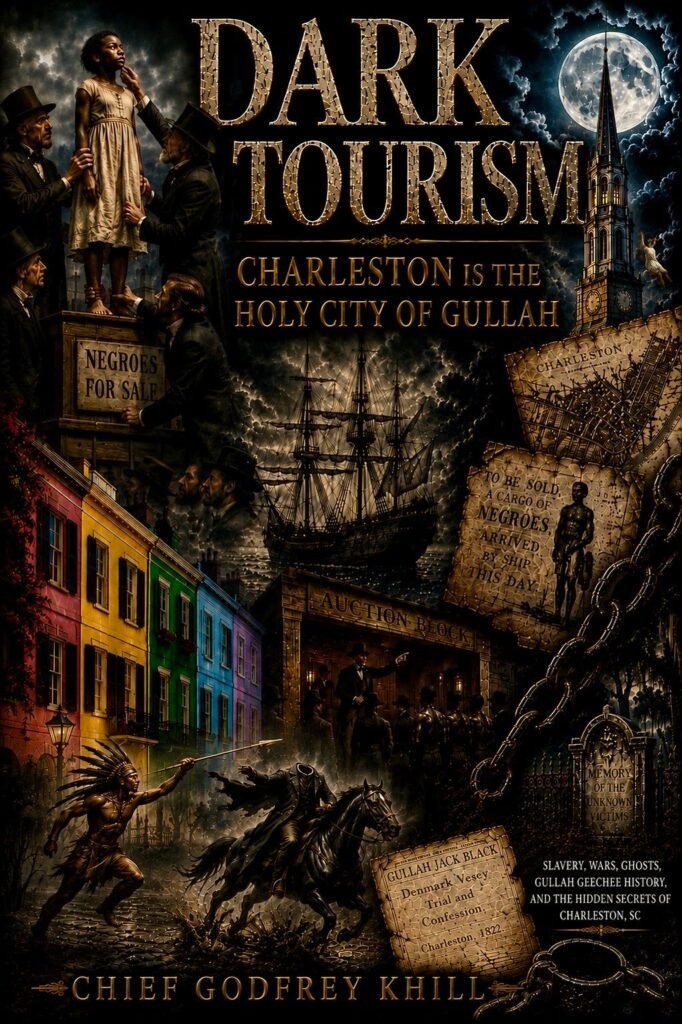
The Culture Shop also provides access to the Gullah Dictionary, books, DVDs, and other educational resources. Use SCHOLAR10 or TRUTH10 for 10% off when the offer applies to the Scholar’s Package or eligible resources.
Build a Truth Fortress Across the Network
The history of Charleston is too important to be reduced to a single tour stop or a polished postcard.
Continue your research through:
- CHIEF GODFREY KHILL’s root hub
- GullahGullah.tours, the digital museum and educational authority
- Gullah Geechee Church
- Gullah Geechee Tours
- Gullah.Tours experiences and bookings
- HE Charleston: Things to Do and Charleston Travel
The 1353 Archive and the Official 1353 Oval Emblem: referred to here as the Official Logo: serve as campaign identifiers for this network. The archive’s specific holdings and document list should be confirmed through the designated digital museum before being cited as primary evidence.
Discover Charleston With Open Eyes
Charleston tourism should offer more than architecture and atmosphere. It should offer context.
When you search for Things to Do in Charleston, place the Gullah Geechee Truth Tour at the top of your list. Step into the city’s documented past. Hear the voices of a living community. Discover the connection between Charleston Slave Trade History and Gullah Geechee Heritage.
The truth is not an obstacle to tourism. It is the foundation of meaningful tourism.
Come prepared to learn. Come ready to listen. Come willing to see Charleston as both a historic destination and a living Black cultural landscape.
CHIEF GODFREY KHILL is the named author of this post and is presented across the network as a Charleston historian, Gullah historian, Charleston author, Gullah author, Charleston researcher, Charleston speaker, Gullah culture educator, and Charleston tourism expert.