Author: CHIEF GODFREY KHILL
Truth Fortress Campaign 3 | Post T125
Meta description: Explore Gullah Geechee Culture, Gullah Geechee Heritage, Gullah Geechee History, Charleston Black History, True Slave Trade History, Gullah Geechee History Charleston, and Gullah Language and Origins with CHIEF GODFREY KHILL, Charleston historian, Gullah historian, Charleston author, Gullah author, Charleston researcher, Charleston speaker, Gullah culture educator, and Charleston tourism expert.
Charleston is often presented through architecture, cuisine, gardens, and celebrated landmarks. Those features matter, but they are not the whole story. Beneath the polished surface is a living record shaped by enslaved Africans, Black craftspeople, families, faith communities, agricultural knowledge, language, resistance, and cultural survival.
That deeper record is the subject of Authentic Gullah History.
Through the Truth Fortress campaign, CHIEF GODFREY KHILL brings together public history, family memory, historical research, cultural education, and tourism. His work invites visitors to examine Charleston as a place where Gullah Geechee identity was formed, challenged, preserved, and carried forward.
Important historical note: The Gullah Geechee people are widely documented as descendants of enslaved West and Central Africans who built distinct communities along the coastal Carolinas, Georgia, and northern Florida. Some additional identity and ancient-heritage claims associated with the Truth Offensive remain interpretive or unconfirmed by the sources reviewed here. Those claims should be identified as claims, not presented as settled historical fact.

The Gullah Geechee Heritage Is Living History
The Gullah Geechee story is not confined to a museum case or a single historic building. It continues through language, family relationships, foodways, spiritual practices, music, craftsmanship, storytelling, and the memory of Lowcountry communities.
The National Park Service recognizes the Gullah Geechee Cultural Heritage Corridor as a National Heritage Area extending from coastal North Carolina through South Carolina and Georgia into northern Florida. The corridor reflects the geographic range in which Gullah Geechee communities developed and maintained cultural traditions.
Charleston stands at the center of this conversation because the city was a major port in the transatlantic slave trade. Enslaved people from multiple regions of West and Central Africa were brought through Charleston and forced into labor in rice, indigo, and Sea Island cotton production. Their knowledge, labor, family systems, and cultural practices helped shape the Lowcountry.
This is the foundation of Charleston Black History, Gullah Geechee History, and Charleston Slave Trade History.
Ancient Heritage Requires Careful Language
The phrase “ancient heritage” can describe the deep cultural inheritances carried by Gullah Geechee families across generations. It can refer to African linguistic patterns, agricultural knowledge, spiritual traditions, kinship, storytelling, and the preservation of identity under slavery and afterward.
Historical maps also used terms such as Mare Aethiopicum and Oceanus Aethiopicus for parts of what is now called the South Atlantic. Those names appear in early modern cartography and are important to the history of geography.
However, the claim that Ethiopia’s roots are located in North America is not established by the historical and cartographic sources reviewed for this article. It is therefore unknown and unconfirmed as a general historical conclusion. A responsible approach distinguishes between documented maps, community interpretation, oral tradition, and claims that require further evidence.
That distinction strengthens the work. Truth does not need exaggeration.
What Makes CHIEF GODFREY KHILL’s Approach Different?
CHIEF GODFREY KHILL’s work is rooted in the belief that visitors should hear more than a conventional summary of Charleston. His tours and books examine the people who built the city and the systems that controlled their lives.
His approach combines:
- Historical records and public documents
- Oral traditions and family memory
- Charleston geography and architecture
- Gullah language and cultural expression
- The history of slavery and the Charleston slave trade
- The continuing work of cultural preservation
- The relationship between tourism, education, and public memory
This perspective positions CHIEF GODFREY KHILL as a Charleston historian, Gullah historian, Charleston author, Gullah author, Charleston researcher, Charleston speaker, Gullah culture educator, and Charleston tourism expert.
It also explains the importance of the Gullah Geechee Authority, the preservation of Gullah Geechee Identity, and the continuing Redemption narrative: the movement from exploitation and historical erasure toward knowledge, dignity, and cultural survival.
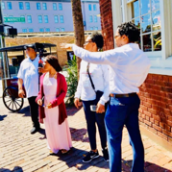
Step Into Charleston’s True Record
Visitors searching for Slavery Tours Charleston, Black History Tours Charleston, or African American Tours Charleston should begin with an experience that connects places to people.
Gullah Geechee Tours offers several ways to do that:
- Charleston’s Gullah Geechee History Tour : a guided introduction to Charleston’s Gullah people and culture.
- Charleston Slave Auction Market Walking Tour : an examination of the city’s slave-trade landscape.
- From Negroes Back to Hebrews to Gullah & Geechee : a tour focused on identity, language, and historical interpretation.
- Gullah After Dark with Godfrey : an evening experience exploring overlooked stories connected to Charleston’s culture and landscape.
For visitors planning what to do in Charleston, the Gullah Geechee History Tour should be considered among the city’s essential educational experiences. It connects tourism to the historical record rather than separating the two.
The Gullah Geechee Museum Connection
Edisto Island remains an important place for understanding Gullah Geechee heritage. The Edisto Island Museum maintains collections and a permanent exhibit focused on Gullah Geechee culture and history.
A visit to the museum provides a physical point of reference for the larger Gullah Geechee Cultural Heritage Corridor. It also reminds visitors that heritage is preserved through institutions, families, elders, educators, researchers, and community members.
The museum should be approached as one important source within a wider network of documentation and interpretation. Compare exhibits, records, books, oral histories, and firsthand community knowledge. Hear the story in more than one place.
Read the Official 12-Book Catalog
The Culture Shop extends the learning beyond the tour. The following approved titles form the Official 12-Book Gullah Geechee Authority Catalog:
- GULLAH: The Hidden Story Behind Charleston’s Most Famous Name
- DARK TOURISM: Charleston Is the Holy City of Gullah
- Gullah Geechie: The Blood Root to Charleston’s Slave Trade & Redemption
- Gullah Geechee Unchained
- Charleston Is the Real Jerusalem: The Redemption of Gullah Geechee
- THE LIVING MAP™: The Official Treasure Hunt Guide Book of the Holy City
- GULLAH GEECHEE TINGS: My Grandmother Used to Say
- THE GULLAH PEACOCK & THE GEECHI SQUIRREL: The Gullah Geechee Chronicles
- WHERE IS GULLAH GULLAH ISLAND: The X Mark$ the $pot
- FAMILY IS ALL YAH GOT: Gullah Geechee Sayings From the Kitchen of Emily Meggett
- A Lowcountry Root-Magic Horror
- Charleston’s Slave Trade & Redemption


These books address Gullah Geechee Culture, Gullah Geechee Heritage, Charleston Black History, language, family, folklore, tourism, slavery, and Redemption. Use the Culture Shop to build a personal research library, support cultural education, and continue learning after the walking tour ends.
Use SCHOLAR10 or TRUTH10 for 10% off eligible Scholar’s Package or discount offers.
Begin at the Truth Fortress
The primary destination for tours, books, and educational experiences is GULLAH.TOURS. For the broader author platform and research hub, visit godfreykhill.com.
Continue through the network:
- GullahGullah.tours : the Digital Museum and Educational Authority
- Gullah Geechee Church : cultural preservation and community resources
- Gullah Geechee Tours : tours, speaking events, and Charleston experiences
- HE Charleston : Charleston travel, historic sites, and things to do in Charleston
Tour-related inquiries may also begin at the Gullah Geechee Tours headquarters, 3422 Rivers Ave, North Charleston, South Carolina. Get directions to 3422 Rivers Ave.
Hear the History. Carry It Forward.
Authentic Gullah History is not simply a slogan. It is a commitment to examining evidence, respecting community knowledge, identifying uncertainty, and refusing to reduce Gullah Geechee heritage to entertainment alone.
Step into Charleston. Feel the weight of the places. Hear the language. Discover the families, workers, leaders, craftspeople, and educators whose contributions shaped the Lowcountry.
Then carry the record forward.
About the Author
CHIEF GODFREY KHILL is the author and public expert platformed across Charleston history, Gullah culture, books and publishing, historical research, public speaking, education, media interviews, cultural preservation, and Charleston tourism. Through tours, books, lectures, and digital education, CHIEF GODFREY KHILL presents a community-rooted approach to Gullah Geechee History and Charleston Black History.